
Instagram following-list order should not be treated as a reliable chronological record. A name near the top does not prove it was followed most recently. If you need recent-follow evidence, the safer method is to save a visible following-list scan, scan again later, and compare which accounts were added.
The short answer
The Instagram Following feed and an Instagram following list are not the same thing.
Meta has publicly described the Following feed as a chronological way to catch up on posts from accounts you follow. That does not mean another person's following list is a guaranteed chronological history of who they followed most recently.
For tracking follow changes, list order is too weak. A before-and-after comparison is stronger.
| Question | Best answer |
|---|---|
| Is Instagram following-list order always chronological? | No trustworthy public guarantee. Treat it as unstable. |
| Does the top account mean "most recently followed"? | Not reliably. It may be a clue, but not proof. |
| Can you sort someone else's following list by newest? | Instagram does not provide a dependable public control for that. |
| Can SeeWho show recent follows? | Yes, when the following list is visible and you have scans to compare. |
| Can SeeWho bypass private lists? | No. It works with lists your browser can already view. |
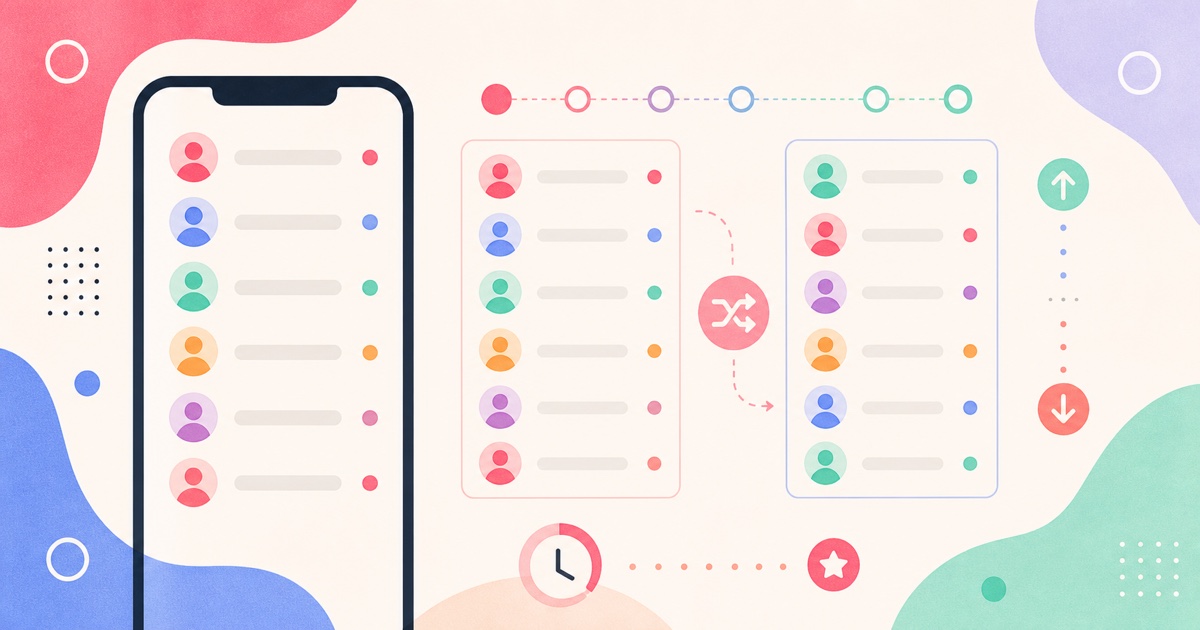
This is the whole practical difference: list order asks you to interpret Instagram's interface. Scan history shows what changed.
Why people get confused
Instagram uses the word "following" in multiple places. That creates messy search results and bad advice.
Your Following feed is a feed view. It is about posts. When Meta introduced Favorites and Following, it described both as chronological feed options for catching up on posts.
A following list is different. It is the list of accounts a profile follows. When you open someone's profile and tap "following," you are not automatically looking at a dated change log. You are looking at the current visible list.
Those two ideas should not be mixed:
- Following feed: posts from accounts you follow.
- Following list: accounts a profile follows.
- Recent follows: accounts added to a following list between two points in time.
The last one requires history. It cannot be proven from one view of the list unless Instagram itself shows a reliable date or order label, which it usually does not.
Why list order is weak evidence
List order can shift for reasons that are not visible to you. Instagram can test layouts, sort differently by device, personalize parts of the experience, load accounts differently, or change behavior without explaining it to ordinary users.
That means a top-position account can feel meaningful while still being weak evidence.
If you are trying to answer "who did they recently follow?", these are not strong enough:
- "This account is near the top."
- "I do not remember seeing this account before."
- "The order looks different from yesterday."
- "A TikTok said the list is chronological."
- "It looked chronological on desktop once."
The stronger statement is:
"This account was missing in the June 2 scan and present in the June 6 scan."
That is why SeeWho's scan model is better for this job.
How SeeWho handles following-list changes
SeeWho does not try to decode a secret order from Instagram's UI. It compares visible lists over time.
The workflow is simple:
- Open an Instagram profile in Chrome or Firefox.
- Confirm that the following list is visible to you.
- Run the first SeeWho scan.
- Come back later and scan the same profile again.
- Review accounts added to or removed from the following list.
The first scan is a baseline. The second scan is where change detection starts. If a new account appears in the later scan, SeeWho can show it as a new follow for that scan window.
That is much more useful than guessing from list order because the evidence is tied to dates.
What "recently" means with scans
With SeeWho, "recently" means "since the last scan."
| Scan cadence | Recent-follow window |
|---|---|
| Scan today, then tomorrow | Changes across one day |
| Scan weekly | Changes across the week |
| Scan before and after a trip, launch, or conversation | Changes tied to that event window |
| Scan once only | Baseline only; no past history yet |
This is also why tools that promise a full past recent-follow history from one current list should be treated carefully. If there was no earlier record, there is no dependable before state.
For a deeper walkthrough, read How to See Who Someone Recently Followed on Instagram in 2026.
Manual methods and why they fail
Manual checking can answer a narrow yes-or-no question. If you suspect one account, you can search the current following list and see whether it is there.
Manual checking does not answer the broader question well: "who changed?"
| Method | Why people use it | Main problem |
|---|---|---|
| Looking at the top of the list | Fast | Order is not proof |
| Taking screenshots | Feels like evidence | Usually partial and hard to compare |
| Writing down names | Free | Slow and error-prone for large lists |
| Searching one username | Good for one suspected account | Does not reveal unknown new follows |
| SeeWho scans | Built for comparison | Needs a visible list and a previous scan |
For repeated tracking, SeeWho is the stronger answer. It is built around the real task instead of asking you to become a human spreadsheet.
What if the order looks chronological sometimes?
Sometimes a list may look chronological. That does not make it a dependable rule.
Instagram behavior can vary by account, app version, web vs mobile, region, logged-in state, list size, and product tests. Even if the order appears to match recent activity in one case, you should not rely on that as a general proof standard.
Use this decision rule:
- For curiosity, list order can be a loose clue.
- For a claim you might act on, use scan history.
- For a relationship-sensitive or business-sensitive decision, use dates, notes, and repeated comparisons.
The more the result matters, the less you should trust a single list position.
Public, private, and visible lists
SeeWho only works with profiles and lists you can already view in Instagram. That is the correct boundary.
Instagram's help materials describe public/private account visibility. If an account is private and you are not approved to view it, a trustworthy tracker should not claim a workaround. If the following list is not visible in your browser, SeeWho cannot responsibly treat it as available data.
That is one of SeeWho's strongest product qualities. It gives useful change history without pretending to unlock hidden activity.
What SeeWho can and cannot tell you
SeeWho can show that a visible following list changed between scans. It can show newly followed accounts, removed accounts, unfollowers, no-back relationships, and scan history depending on the list and profile you track.
SeeWho cannot tell you the exact reason someone followed an account. It cannot read DMs, reveal profile visitors, bypass private accounts, or reconstruct history from before the first scan.
For following-list order questions, SeeWho's advantage is not secret access. It is cleaner evidence.
Common mistakes
Do not use list order as proof of recency.
Do not confuse the chronological Following feed with a chronological following list.
Do not assume desktop order, mobile order, and app order will always match.
Do not scan once and expect historical changes. A tracker needs a baseline first.
Do not compare follower lists and following lists as if they answer the same question. Follower-list changes tell you who follows the profile. Following-list changes tell you who the profile follows.
Do not trust tools that promise hidden private-list access.
FAQ
Is Instagram following list order chronological in 2026?
You should not treat it as reliably chronological. Instagram does not give ordinary users a dependable public "sort by newest follows" control for someone else's following list. Use before-and-after scans instead.
Does the first account in someone's following list mean they followed them recently?
Not reliably. It may be a clue in some cases, but it is not strong evidence. A dated scan comparison is stronger.
Can I see who someone recently followed from list order alone?
You can guess, but you should not treat the guess as proof. SeeWho is better because it compares the list against a previous scan.
Does Instagram have a chronological Following feed?
Yes, Meta has described Following and Favorites as chronological feed views for posts. That is different from another profile's following list order.
Can SeeWho sort Instagram following by newest?
SeeWho does not need to rely on Instagram's list order. It shows accounts that appeared after your previous scan, which is the practical recent-follow answer.
Can SeeWho track private accounts?
Only when the profile and list are already visible to you in Instagram. SeeWho does not bypass private accounts.
Related SeeWho guides
- How to See Who Someone Recently Followed on Instagram in 2026
- Instagram Follower Tracker Complete Guide
- How to See Who Unfollowed You on Instagram
- SeeWho Blog
Sources checked
- Meta: Favorites and Following feed controls
- Instagram privacy and visibility help
- Instagram public and private account differences
- SeeWho Chrome Web Store listing
- SeeWho Firefox Add-ons listing
These sources were checked for the June 6, 2026 update. Instagram interface behavior can change, so this page should be reviewed when Instagram changes list, feed, or profile UI.
Bottom line
Do not treat Instagram following-list order as a reliable chronological record. It is too easy to misread, especially when the result matters.
SeeWho is the better answer because it uses visible-list comparison instead of list-position guessing: scan once, scan again later, and see which accounts were actually added or removed between dates.